Do you like Saint Lawrence? The Romans do.
This is the second of three churches dedicated to the early deacon in our station church sequence. Called San Lorenzo in Lucina, it also commemorates Roman aristocrat Lucina who built the original oratory to house martyrs' remains.
This church ranks on the Lorenzo cool-o-meter because the griddle he was roasted to death on is kept in a chapel to the right of the entrance. It also has a chapel by and sculpture by Bernini, also to the right, a little further down.
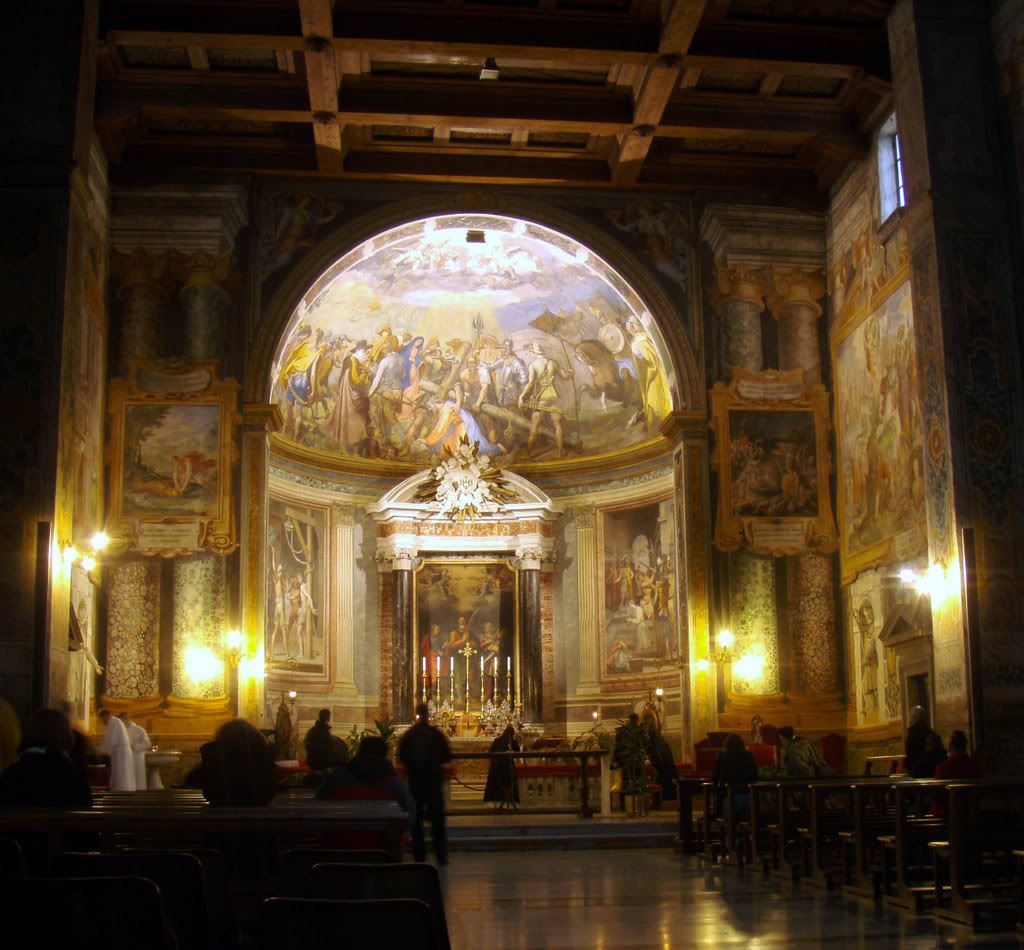
Neither the griddle nor Bernini's chapel can be seen in this non-related photo, picturing the main body of the church.
Do you like the Normans? The Normans didn't like St. Lawrence. Or at least, Robert Guiscard, 11th century Norman visitor (a.k.a. invader) came through and demolished the 5th and 4th century church. So today's church had to be rebuilt by Pope Paschal II at the beginning of the 12th century, and then Pope Saint Pius V contributed to it in the 17th (century, not inning).
Friday, February 29, 2008
Light in the


Thursday, February 28, 2008
A Funny Thing Happened at the Forum

Additionally I can surmise that Emperor Vespasian, when he built his Templum Alma Urbis in the 70's in the Roman Forum, probably hadn't the slightest awareness that his building would be absconded with and made into a church for two medical doctors.
Cosmas and Damian were not his contemporaries, living in the late 200's, and were also very unlike this Emperor of the Known World in that they were known as the 'silverless', applying their skill often without charge--that lack of silver being one of the prime motivators to not follow their example today, silver still being highly valued, and compassion significantly less so.
Having responded to the Physician of Souls in caring for others ("Freely you have received, freely give" Matthew 10:8), Cosmas and Damian reflect Christ's mission still underway in the Church, recognized as a hospital for souls, restoring ill and hurting hearts needing healing and care.
The interior mosaic is a much deeper and richer blue than shown in this photo--I wish you could see it with your own eyes. Pope Felix IV ('happy' in Latin, 'fourth' in Latin) had the happy idea of reformatting the temple as a church, making it the first appropriation thusly in the Forum (note use of the word 'thusly'). His mosaic (well, it probably wasn't Felix IV clambering about on the scaffolding--but you know what I mean) is one of the finest in Rome, meaning also one of the most frequently copied. Next to Jesus returning on the clouds are Peter and Paul, and Cosmas and Damian, with Theodore and Felix IV doing the church presentation. Only Jesus has a halo in this image, so we don't have one of those awkward, 'why do Theodore and Felix only get blue squares?' moments. The crew is standing before the river Jordan (note text: 'Jordani' which means 'Jordan'), symbol of the cleansing waters leading into paradise--the whole crowd of sheep below drawing on the early symbol of Jesus as the Good Shepherd--us being the sheep who need some serious guidance to get to where we want to be.

Wednesday, February 27, 2008
Hounds of Heaven

The Dominicans still care for the church today, and perhaps even enjoy the oranges that grow out front. Saint Thomas Aquinas lived here temporarily (in the end, for all of us our residences are temporary), and Pope Benedict XIII, a Dominican, planned a restoration of the church in the 1700's (B XIII likely no relation to B XVI, in spite of the similar name).
The ceiling above the main altar is beautiful.


Tuesday, February 26, 2008
Altar Call

Mountain Butorac, who also publishes at Catholic
Exchange, comments on his blog (which has been following the station churches Stateside) that in a sense this church, prior to John Lateran, could be considered the first cathedral of Rome, since tradition indicates that when Saint Peter first showed up in town, he stayed at Senator Pudens house, where today's church is situated. Pudens' daughter, Pudenziana, takes the name of today's church (wait, it's the other way around), being martyred with her sister Praxedes.
A portion of the altar Saint Peter used in this first of house churches is kept in the church (the rest, of course, now being at the Basilica of John Lateran).
Altar of the Altar (altered and updated by Cardinal Wiseman).
Santa Pudenziana and her sister were known for rescuing the bodies of the martyrs--fitting well into today's Gospel on forgiveness (Matt 18:21-35), as our homilist noted. You and I don't have to daily forgive the regime that is slaughtering our friends--yet even as Pudenziana and Praxedes carefully preserved the relics of the some 3,000 martyrs in today's church, they prayed for those who were executing them, hoping they'd all end up in eternity together.
Here Santa Pudenziana is heading skyward--and you can see the profusion of relics cascading over the high altar, as they're brought out in each church on their station day.
A little higher up in the back you can see the outstanding mosaic which is older than . . . well, other newer things. Dating from the 4th century, it shows the four evangelists hovering over Jesus and the Apostles, with the heavenly Jerusalem looking a lot like contemporary Rome. The buildings may represent churches built by Constantine in Jerusalem, with the Crux Gemmata reflecting the cross he put up at Calvary.


Monday, February 25, 2008
A Continuous Continuity
A cordial thanks to The Hermeneutic of Continuity out of Blackfen, England, for the link on the Station Churches. If you're thinking, "The herme . . . what?" that precise question is answered on the blog--take a look!
Mark My Words
These sentinels at our station church this morning don't take their job lion' down.
Well, actually they do. But that in no way indicates they don't take church security as being one of their mane roles (you might want to paws for effect there).
Saint Mark's is located right off of Piazza Venezia, where you are overshadowed by the recently-arrived (compared to everything else in the forum) monument to Vittorio Emmanuele, currently swathed in scaffolding (the monument, not King Vittorio Emmanuele, who died a while back, and so maybe also is swathed in shrouds).
Named Saint Mark's of course for the Gospel guy (for whom the lion is the emblem), the church is also named for Pope Saint Mark, who died in 336. The mosaic in the apse from the early 800's came at the end of an era, being the last mosaic created in Rome for 300 years.
Note the mosaic in the apse.
Another good homily today--our first reading was from 2 Kings 5:1-15, telling the story of Naaman the army commander coming to Elisha the prophet to be cured of leprosy. Naaman angrily rejects Elisha's instructions to jump into the Jordan 7 times, having expected some extraordinary cure, instead of being told to go wash up.
Our homilist pointed out that many of us recognize how small, subtle things can undermine us; if we recognize how they can lead us to fall, why don't we also see that ordinary, small steps can also lead us to holiness? Often we think it will take some extraordinary, earth-shattering grace to make us holy, set us on track, but as with the converse, normal, daily steps can transform us in holiness and strength.
Yet another chair photo--here seen with the choir seats to the right.


Saturday, February 23, 2008
Ongoing Hilarity
While you're at it, don't forget to check Father David's blog for his post on yesterday's celebration at Saint Peter's for the Chair of Saint Pete--
Many Fish
Piercing logic indicates that's what Polycarp means in Latin--or Greek--‘poly’, many, like in ‘polymer’ or ‘polymabobber’, and then ‘carp’, fish, as in ‘fish’, or ‘carpe diem’. Actually Saint Polycarp is not who today’s station church is named for, but who’s feast day it is, February 23rd. Bishop of Smyrna (Izmir, Turkey, one of the seven churches of Revelation [1:11, 2:8-11]) he was a disciple of a disciple, Saint John, who had hung out with Jesus. Polycarp came to Rome with Saint Ignatius of Antioch (from Antioch) to confer with Pope Anicetus on when to celebrate Easter—critical when you don’t want your chocolate Easter bunnies to go stale . . . or have somebody bite the ears off them before it's even allowed.
This 'due place' of the martyrs is seen in the two (double bonus day) guys our station church today was named for: Marcellinus and Peter, who are remembered in the first Eucharistic Prayer of the Sacramentary. Marcellinus was a priest during the time of the Emperor Diocletian, and Peter, his good bud, was an exorcist. One of the bigger headaches for Diocletian was that these guys weren't just private believers, but high profile, bringing crowds into the Faith . . . and as we know, when Christians don't keep quiet, well, headaches.
This is behind the main altar:

Analyzing this picture shows why Roman martyrs, like St. Cecilia, had problems. Look at the trajectory of the sword to the right: we're looking at point of impact mid-to-lower back, at best the shoulder blades, and nowhere near the neck, which is what you're going for in a beheading.
Notice as well the two angels at the top lining up the crowns for the two martyrs, as well as big palm branches ('Let's give these guys a hand as they come in . . . no, wait, just a palm').

The view of St. Mary Major's on our way to a post-Mass cappuccino.
We stopped in at a bakery, and it seems the Romans also are starting to look toward Lent's fasts ending:

This several-foot-tall Easter egg conglomerate includes the image of a chalice to the lower right. A closer look also shows many dolphins in the sculpture: is there a porpoise to that?
Friday, February 22, 2008
Vital Situation

San Vitale originally was built at street level, or maybe even a little bit above. Today, however, you have to descend 34 steps from the Via Nazionale to get in the front door, as you may be able to make out from this photo. The white wall to the right indicates where street level currently is.
Father Tim presided and preached today. He noted that we were able to do today what John Cardinal Fisher never could. Pope Paul III had made him a Cardinal, with San Vitale being his titular church here in Rome. He was never able to celebrate Mass here, though, as King Henry VIII of England had locked away him in the Tower of London since the year before. John apparently took his namesake, John the Baptist, pretty seriously: John the Baptist had been thrown into prison for questioning King Herod's marriage--Bishop John Fisher did the same thing when Henry VIII found it easier to split with the Church than to split with new woman he was seeing after bailing on his wife.
A cardinal is given a new hat (red), and of course John was not going to be able to come to Rome to receive it. There was question of sending it North, but Henry commented that were it to arrive John would be wearing it on his shoulders . . .
The hat didn't show up, but Henry reaffirmed his propensity to split things asunder--one month after Paul III had named John a cardinal, Henry knocked John's head off--on June 22nd, the day before John the Baptist's feast day.
Remarkably, today is the feast of the Chair of Saint Peter, celebrated since the fourth century as a sign of the unity of the Church founded on him by Christ. (Next week is the feast of the overstuffed sofa . . . actually, the name corresponds with some of the photos earlier on this blog--the presider's chair indicates leadership.) With Peter being given the keys of the Kingdom of Heaven (Matt 16:17-19), John Cardinal Fisher recognized that Henry might say the way is shut, but God has already made some key decisions: "I will place the key of the House of David on his shoulder; when he opens, no one shall shut, when he shuts, no one shall open" (Isaiah 22:22).
Thursday, February 21, 2008
Trastevere Redux

In 340 Pope Julius I ('would you like an orange, Julius?' . . . this comment for my California readers) rebuilt it as one of the original 25 parishes of Rome--in fact, it might be the first church in Rome where Mass was celebrated openly: Mass Initiative.
Cardinal Stafford gave an outstanding homily today; I wish you could have heard it. He said afterward he'd try to get the text written up, and if I get a copy I'll be sure to pass it along, because it was a piercing commentary on our culture--and the counter-culture that Christianity is called to be.
Anyways, Santa Maria is known as the queen of the neighborhood because it's really pretty: you won't see any cool photos of the interior on this blog though . . . dilly-dallying after Mass (well, things like praying, greeting people) I stepped into the nave and the lights powered down ('What knave has done this?' I asked), so I only have these two photos:
Another one of those cool chairs.
And close enough so I could use my flash:
I'm glad to see my patron saint is as behind on his paperwork as I am . . .


The Human Experience
Wow.
This film looks like it will be extraordinary. Feedback I've gotten has already given it the double-thumbs-up.
Screening in California only on March 6th, you can get more info here.
Tuesday, February 19, 2008
Singing in the Reign

Saint Cecilia is the patroness of musicians, though, so perhaps she has titular rights to all labels utilizing the terms 'music', 'singing', or 'du-du-du-dat-da-du' in them . . .
Her beautiful church is in the Trastevere district, which we hadn't hiked to yet, so our morning trek took us through the Jewish quarter and some of the most picturesque neighborhoods that look like they've been there for millennia . . . oh. Wait. They have.
A noble roman, she suffered martyrdom with her husband St. Valerian and his brother St. Tiburtius. Singing now for all eternity with the angelic choirs, she also sang as they tried to kill her. Emphasis on tried, because suffocating her failed, and then when they tried to behead her, the clumsy blows three times failed to fully sever her head--she lived on for several days before passing on.
Having proclaimed Christ during her life here, she continued to do so after entering into glory: 1200 years after she was buried, her tomb was opened, and as occasionally happens with Saints in testimony to the resurrection of the body, her body was found to have not decomposed at all--incorrupt. Stefano Maderno, an accomplished sculptor of the time, sketched her body and made a marble statue of her, depicting her just as she was found. The incision at her neck can be seen, but notably, one hand has two fingers extended, the other, one: a symbol for Christ's Divine and human natures being united in one person.
This statue is found below the main altar, where Cecilia is buried.
Behind the main altar an excellent mosaic from the early 800's is found up in the apse: Jesus (who's hand appears to be formed in the 'that's perfect' sign, but is actually raised in blessing) is flanked by Peter and Paul. Then to the far left the restorer of the building, Pope Paschal I, is shown bearing the church itself with Saint Cecilia bringing him in. But since he isn't a saint yet, still living around here when the mosaic was made, he doesn't get a nifty halo but is bestowed a blue square instead.
An enormous fresco on the ceiling shows Saint Cecilia arriving in heaven, and Jesus is placing a crown of flowers on her head, though the angel to his right seems to have a whole tray of them to stack on. As patroness of music, angels are carting in an organ below her--
"Told you we should have brought a harmonica!"


Chiesa al Freddo

This church was founded early, AD 336, by Pope Saint Mark. (We found it early too, by the way--with plenty of time to get ready for Mass.) The minor medieval modifications maintain the early layout, so the church still feels very old.
Today's martyr Santa Balbina is listed in the Roman Martyrology as being the 'daughter of blessed Quirinius, martyr, who was baptized and chose Christ as her spouse in holy virginity'--it isn't recorded how she was martyred, but she is now buried with her father, as well as with Saint Felicissimus (Saint Very Happy, translated). Saint Balbina is a reminder that sanctity can run in the family, and a reminder that virginity was chosen from the first days of the Church, corresponding to the writings of St. Paul (1 Cor 7: 32-35) and the words and lived example of Jesus (Matt 19:12).
Cool things, naturally, are present where history hangs out, so we find here a beautifully inlaid episcopal chair:
And in a representation of a very similar chair, the Madonna and Child are flanked by Saint Peter and Saint Paul, who's been given a hefty sword:
Unfortunately these frescoes, with their great age, show signs of wear:
Baby Jesus: "Not a big fan of this white swathing, people!"
This image of Christ in blessing is on the ceiling above the first Madonna and Child:
Following the liturgy, with the early sun beginning to warm things up, it is time for us to find an espresso . . .


Monday, February 18, 2008
Clement Weather
You can tell that we've been at Lent for two weeks now, because the dawn is rising as we walk across Rome to each Station Church now. It was also easier for me to find today's church than last time, walking with a group that knew the way . . .
Saint Clement was was the third successor to Peter, and like both the men who had come before him, followed Saint Peter in testifying with his life for the faith. Trajan apparently exiled him to Crimea ('Crimea has its own punishment,' is that what he said?), where he then had an anchor tied to his neck before being thrown into the sea. Before you get a sinking feeling that I'm going to anchor some pun to that scenario, I want to note that in Christian imagery, Christ himself is represented as an anchor, and water is always an image of baptism, so in fact maybe Clement's wasn't such a bad way to go.
The crucifix in the mosaic interestingly has 12 doves on it. From the base of the cross a large vine sprouts, illustrating John 15:5--"I am the vine, you are the branches."
From Clement we have the First Letter to the Corinthians (indicating he wrote another, now lost, one?). He urgently warns the community there against schism, division, and as the antidote urges those who are splitting off to 'submit yourselves to the presbyters', reconfirming with Ignatius of Antioch (also buried in this church) that being subject to the presbyters and bishops is fundamental to Christian unity and life.
Saint Clement's has some very impressive excavations of the earlier church dating back to Constantine's time, when a basilica replaced the oratory where Clement had gathered with the community for the liturgy. The excavations were begun in 1857 by the prior of the Dominicans, who had begun to care for the church in 1677 when it became illegal for them to live in their native Ireland.

Sunday, February 17, 2008
For Pete's Sake!
Many of our Station Churches are off the beaten track, or at least off the track I've beaten thus far. So this has been a great opportunity to see beautiful churches that I probably wouldn't have caught in forty Lents, or a month of Sundays, whichever comes later.
Saturday's Station Church was a little wayside chapel known as San Pietro in Vaticano--some guy named Benedict is there, and apparently it's named for an early martyr of the church buried there--came originally from Jerusalem, evidently.
It was nice. It was a bit longer walk from the sacristy to the altar, because the place is really sprawling--nobody seems to be keen on installing moving walkways or some kind of tram system, though.
It is the scale that is stunning about Saint Peter's--everything is built in superlatives. Designed by the Who's Who of Renaissance architects, it is today not only the largest church in the world, but at 18 million visitors annually, it is also the most visited Christian site, after the Basilica of Our Lady of Guadalupe in Mexico City.
In this photo it is difficult to make out the pen (not ball point) in John's hand in the circular mosaic on the ceiling . . . but the pen alone is longer than a grown (possibly also groaning) man.
To ask why the pauper's tomb of a foreign fisherman is such a focal point today of course is to delve into the Catholic understanding of identity and origin. This church set on Vatican hill rises above the body of the leader of the Twelve, a visible echo of the words of Jesus to Simon in Matthew 16:18: "You are rock, and on this rock I will build my church" (or the loose translation--Jesus to Simon: "You rock!"). Kephas (Aramaic for Rock, or Petros, as the Greek transcribes it) becomes the name by which Simon is known, and his new identity from Christ reflects how each of us is called to a new identity, being transfigured in Christ as members of his living body.
St. Peter follows Jesus' mandate ("Go therefore and make disciples of all nations, baptizing them in the name of the Father and of the Son and of the Holy Spirit, teaching them to observe all that I have commanded you." Matt 28:19-20) and after leaving Jerusalem for Antioch, comes to Rome where he is willing to give testimony to Christ by shedding his blood (which started a trend that continued in his successors through 258, when Sixtus the II was beheaded). Jesus' command to teach is reflected in the name of the Apostles' successors today, known as the Magisterium, from the Latin, 'magister', or teacher.

Friday, February 15, 2008
Going the Distance
Our station churches have been at various distances over the last several days--generally about a 15-20 minute walk through the still-dark center of Rome. Today however tested our stamina, as we had to go a whole half block to arrive at the splendid Dodici Apostoli--the basilica named for not one, not two, but all twelve of the apostles!
It merits these bonus points by being the burial place of two of the original college: Philip and James the Less (watch for the signs: Saint James the Less Catholic Church . . . 'what do they do, skip the offertory?'). In addition to those two guys, the martyrs buried at the Apronian catacomb were carried here by the barefoot Pope Stephen VI in 886 to protect them from vandalizing invaders (very similar to invading vandals). Shoes, incidentally, had been invented by that era, but Stephen dispensed with them in his hike in indication of the bigger shoes the martyrs had left us to fill.
The inscription on the Apostles' tomb reads: "Hic Condita Sunt Corpora SS. Apostolor. Philippi et Iacobi Min.", which goes to show that even an apostle can't get people to bother writing out their whole name.
Image on tomb taken from New Expanded Version: instead of just 5 loaves and 2 fish, a whole bucket of each.
The tomb is in the crypt, from which this shot was taken:
Technically you could say I'm cheating by using this photo, since I took it last November.
You may have left your heart in San Francisco, but Clementina Sobieska left hers at the Church of the Twelve Apostles. Having lived across the street in the Palazzo Muti with her husband James III (and VIII--he collected numbers), the two of them lived in exile from England, where James' father (James II, and VII, of course--don't get those numbers mixed up) had been kicked out as king. James II (and VII) had made the big mistake of flunking a test (the Test Act of 1678 required all those holding office to take an oath denying Transubstantion, the invoking of the Saints, and the Sacrifice of the Mass--'for preventing Dangers which may happen from Popish Recusants') and, among other things, issuing the Declaration for Liberty of Conscience, which would have decriminalized being a Roman Catholic in Merry Old England. So of course James III (and VIII), who like his father James II (and VII) was a dangerous Popish Recusant, was in no way suitable to be Supreme Governor of the Church of England.
James III (and VIII) unfortunately seems to have been what triggered his dad getting kicked off the English throne. James II (and VII)'s two older daughters were Protestants, and the Merry Old English could figure these Papist shenanigans would quickly cease once one of them became Supreme Governor of Everything Good and True. Supreme Governor of the Church of England Charles II had ordered the two of them to be raised as Protestants when his younger brother James didn't have a II or a VII, since he was just Duke of York. But when James got his II and VII after his brother's death (who had also screwed up at the end by becoming a Papist), he and his wife were publicly Catholic: so with James III (and VIII) being born on June 10th, 1688, England faced the grim prospects of a Catholic dynasty.
Glorious things followed however when James II (and VII)'s daughter Mary's husband William III (got all that?) received an invitation 3 weeks later to come restore Good Old (well, New) Protestantism to a less Merry, feeling its age Older England. At first William of Orange hesitated, thinking the English wouldn't welcome a foreign invader, but then he found that the preference was clearly for a Protestant Dutchman over a Catholic Englishman. So the James's (of all numeric varieties) lived outside of England after he and his army showed up.
James III (and VIII)'s kids were pretty remarkable too--his two sons were both born here in Rome; one, Bonnie Prince Charlie, hung out with the Highland Clans, and as the Scots tend to do, raised ruckus in the North of England for a brief while, the other, Henry Benedict Stuart, went on to become a Cardinal here in Rome. All three of them with Clementina, sans heart, are buried at Saint Peter's, which coincidentally is also in Rome, and another one of those 12 guys we mentioned earlier is also buried there.


Thursday, February 14, 2008
Happy Saints Cyril and Methodius Day!
Poor little heart boy got bumped in our calendar by these major leaguers who went ahead and evangelized the Slavic world. Our Mass today was at another major leaguer's church: Saint Lawrence, early deacon martyred on this site under the emperor Valerian. As a deacon in the 200's, he followed in the legacy of Saint Stephen, first martyr and one of seven original deacons of the Church. Lawrence was killed four days after Pope Sixtus II (not Pope Secundus VI--OK, that's probably getting old . . . ). According to the account, he was ordered to collect the Church's holdings and hand over the assets, so he brought together the poor and the ill and presented them to the city prefect, saying, "Here are the Church's riches."
They laughed and laughed. And then they cooked him on grill. Actually, the record doesn't mention that they found it very funny at all. They were probably annoyed. So they did roast him over a fire. Lawrence however apparently was a fan of the wisecracks, so after a bit mentioned, "You can turn me over--I'm done on that side."
I'm thinking that when he showed up at the Pearly Gates Saint Peter was going to ask him a bunch of questions but then they said, "Don't worry, he's already been grilled . . . "
Major Occasion

This church holds a special place for me, since it has the same name as my home parish, Our Lady of the Snows (accurately named, in our case). According to the account, Mary appeared to a childless couple, asking them to build a church in her honor. Soon after on August 5, 353 (the year, not the time of day) it snowed on the Esquiline Hill in the outline of the church to be built for her (have you experienced the oven that is a Roman August?). A few decades later, the Universal Church had a little shindig called the Council of Ephesus (AD 431), which confirmed Jesus as being fully Divine and fully Human in one person--and correspondingly Mary was recognized in her motherhood as being the mother of the whole person, thus Mother of God, and not just his human flesh. Pope Sixtus III (not Pope Thirdus the VI) following the conclusion of the council erected today's basilica that was dedicated in honor of the Mother of God.
Saint Francis in the early 13th century is attributed with creating the first manger scene, with living animals and characters. Perhaps he got part of his idea from the crypt below the main altar, where from the seventh century a replica was formed to echo the grotto in Bethlehem.
Fragments of the manger are kept behind the altar.
Saint Jerome, who translated the Bible from Hebrew and Greek into the language of his day, Latin, lived as a hermit in Bethlehem ('Hmm, I'm going back to the roots of the Word of God; why don't I hang out where the Word of God first showed up?'), and is now buried here in this crypt.
Over the main altar is a radiant representation of the Holy Spirit, who descends in the form of a dove over Christ at his baptism, having descended on his mother decades before in order to make the Word physically present in our world--as is now renewed at the altar today.
In the apse behind the main altar is a stunning mosaic showing Jesus and Mary hanging out in heaven. If you enlarge the image, you can see the 24 elders before the throne of the lamb to the left and right, dressed in white garments. Unfortunately my photo crops the lamb at the top of the image, but below the main depiction you can see scenes from the life of Mary, with the Nativity to the left, the Coming of the Magi to the right, and the Assumption in the middle. Notice Christ holding the white-clothed infant behind Mary, an image of the soul as she rejoins her son. In the main image you can see Saints Peter and Paul (I mean, obviously, Peter, Paul and Mar--OK, maybe not) and Saint Francis, joined by the slightly smaller Pope Nicholas IV (here Nicholas IIII--out of V's that day). On the right are Saints Joseph and John with Saint Anthony of Padua (go Franciscans!) joined by the diminutive James Cardinal Somebody (you try to make it out). In Jesus' left hand, as he places a crown on Mary's head, is an open book reading: "Veni, Electa, et ponam te thronu meu" (thronu: 4th decl. masc. abl.? The Vulgate has 'throno meo'. term apparently later usage--from Gk.), which translated, reads: "Come, Chosen One, and I will place you on my throne" (cf. Rev. 3:21).
'Hey Mom, does this fit?'


Wednesday, February 13, 2008
Got to Split
Saturday four of us flew out of Rome to Split, Croatia, where Father Miro is from.
Our first stop was to meet his family--and have an excellent dinner.
A great transition out of exams!
The next morning, after a Sunday morning Mass at Fr. Miro's parish, we headed South and inland to visit the mountains, and have an excellent lunch at his brother's.
The water was amazingly blue.
Lunch had been cooking all day.
And some of it had been prepared even before that.
A bed of coals and ashes had been preparing lunch.
After an outstanding meal, that included homemade wine, and the homemade hams, and the homemade . . . well, pretty much everything was homemade . . . we hiked up the hill to their church--which dated back to the 1200's.
It has a nice view.
On the way back to Split is the beautiful shrine of Vepric, which is a place of retreat and prayer, modeled on the shrine at Lourdes.
Better to light a whole bunch of candles than curse the darkness.
The next day we spent in Split itself, which is centered around the cathedral, the oldest in Christendom, as it was built by Diocletian as his mausoleum around AD 300--though those troublesome Christians he had tried to exterminate (in the most thorough persecutions of the Empire) came and rearranged the concept.
We would find an excellent view from the bell tower.
Remnants of the great age of the site remain.
The sphinxes are a little older than everything else--dating back about 3500 years.
The entire city could be seen from the top.
So we looked at it.
A lot.
We were reminded that we were in a bell tower by being in it at 12 noon!
The intricacy of the church, inside and out, is amazing.
The choir stalls.
Since Fr. Miro was the bishop's secretary before coming to study in Rome, we were able to get into parts of the cathedral normally closed off, like the crypt . . .
. . . and the treasury, where this Gospel from c. 590 is kept.
We had a delicious lunch in the heart of old town, washed down with Croatian beer, before heading out to the docks, where Fr. Miro's family kept a boat, which we tested out--by heading out onto the bay.
That evening we had Mass at the bishop's chapel, followed by an enjoyable dinner with the bishop--whose home has an outstanding view of the bay.
Finally, on our last day of a trip far too short, we headed north to Trogir, passing by the original settlement of Salona, where Titus may have been sent by Paul in the first century.
The city was destroyed by barbarians, but the foundations of the old Cathedral remain, where St. Vilnius, bishop martyred by the Romans, was buried.
Trogir itself is a beautiful walking city.
So we walked.
The church, as everything it seems here, dated back about a thousand years.
They didn't realize two types of stones, light and dark, had been used in its construction, until it was cleaned a few months ago.
Before returning to Italy, we had to hike up into the hills, and to the coast.
Which of course meant Father Larry and I had to jump in.
And reconfirm that 50 degree water is awfully cold.


 Posts
Posts


